How to Verify Botanical Extract Quality: 12 Points
July 8, 2026 · 12 min read
Why Quality Verification Is the Most Important Skill
A 2024 industry survey found that 60% of buyers who had a quality issue with a botanical extract said the issue was discovered after the shipment arrived — meaning the issue was not detected at sample stage, not detected at supplier level, and only became apparent during the buyer’s own QC testing.
The same survey found:
35% of buyers had experienced a major quality issue in the past 2 years (failed heavy metal limits, microbial contamination, or active compound below specification)
22% had received a shipment that did not match the COA
15% had a stability issue (product degraded faster than expected)
8% had received adulterated product (different botanical source, synthetic compounds, or undeclared additives)
The cost of a single quality issue can be devastating:
This guide provides a 12-point quality verification checklist that any buyer can implement, regardless of the specific botanical extract or supplier.
12-Point Quality Verification Checklist
Step 1: Verify the COA is From a Real, Recent Batch
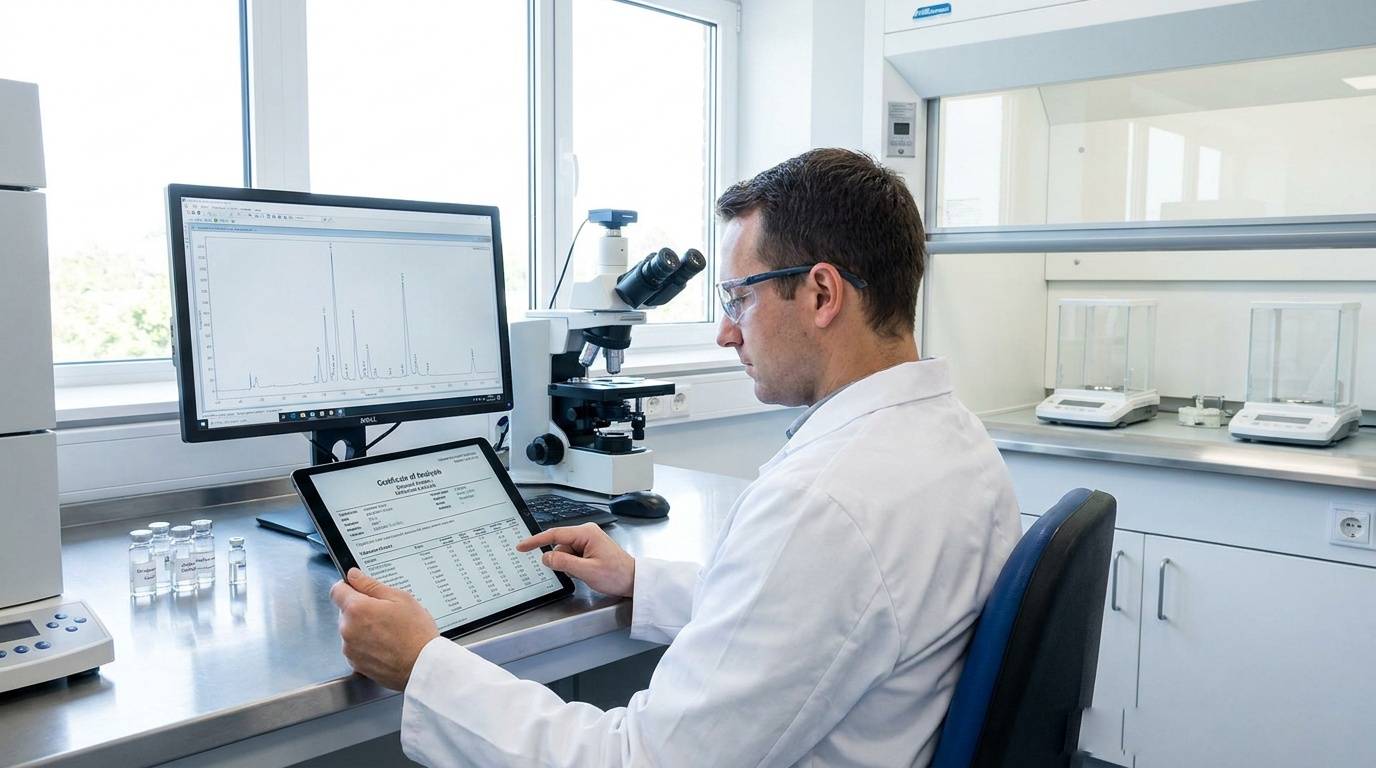
The first verification is whether the Certificate of Analysis (COA) you receive is from a real batch of the actual product, not a fabricated or older document.
Verification questions:
– What is the batch number, and can the supplier trace it to a specific production date?
– When was this batch produced? (Most recent 3-6 months is ideal for fresh botanical extracts)
– Can the supplier provide the HPLC chromatogram corresponding to this COA?
– Is the batch number unique to this lot, or is it a generic number reused across batches?
Red flag: A supplier who cannot produce a recent COA with a specific batch number, production date, and matching chromatogram is not following basic quality documentation practices.
Step 2: Verify the Analytical Method on the COA
The COA must specify the analytical method used for active compound quantification.
Acceptable methods (depending on compound):
– HPLC (High-Performance Liquid Chromatography) — most common
– HPLC-MS or LC-MS/MS — most accurate
– HPLC-PAD (Pulsed Amperometric Detection) — for sugars and sugar alcohols like DNJ
– GC-MS — for volatile compounds
Unacceptable methods:
– “UV-Vis total phenolics” without specifying which compounds
– “Titration” for specific active compounds
– “HPLC” without method reference
Verification: The COA should list:
– Method number or reference (e.g., “USP <621>”, “in-house method SOP-QC-005”)
– Instrument used (HPLC model, detector type)
– Reference standard source (USP, EP, or in-house standard with traceability)
– Limit of detection and quantification
Step 3: Verify Heavy Metal Testing
Every botanical extract COA should include heavy metal testing. The minimum required parameters:
Heavy Metal
USP Limit
EU Limit
Notes
Lead (Pb)
< 5 ppm
< 3 ppm
Most common issue
Arsenic (As)
< 1.5 ppm
< 1.5 ppm
Critical for safety
Cadmium (Cd)
< 0.5 ppm
< 0.5 ppm
Accumulates in plants
Mercury (Hg)
< 0.1 ppm
< 0.1 ppm
Less common
Red flag: A COA that does not include heavy metal testing is incomplete. Always request the latest COA with all four heavy metals tested.
Step 4: Verify Pesticide Residue Testing
Botanical extracts are agricultural products. Pesticide residue testing is essential for export to the US and EU.
Required testing:
– US (FDA): Multi-residue screen for organochlorines, organophosphates, carbamates, pyrethroids
– EU: 500+ pesticide residues per EU Regulation 396/2005
– China: GB 2763 standards
Verification: The COA should specify:
– Number of pesticides tested (minimum 200 for US, 500 for EU)
– Limit of detection for each pesticide
– Maximum residue limits (MRLs) used as reference
Red flag: A COA with only “pesticide residue: not detected” without listing specific pesticides tested is not adequate documentation.
Step 5: Verify Microbial Testing
For food and supplement applications, microbial testing is required:
Total aerobic microbial count: < 10^3 CFU/g (typical)
Total yeast and mold: < 10^2 CFU/g (typical)
E. coli: Absent in 1g or 10g
Salmonella: Absent in 25g
Staphylococcus aureus: Absent in 1g
Verification: The COA should include the actual results for each test, not just “pass” or “meets specification.” Look for actual CFU/g values.
Step 6: Verify Residual Solvent Testing
Most botanical extracts are produced using solvents (ethanol, hexane, methanol, water). Residual solvent testing is essential:
Ethanol: < 5000 ppm (USP <467>)
Methanol: < 3000 ppm
Hexane: < 290 ppm
Acetone: < 5000 ppm
Verification: The COA should specify each solvent and the actual measured value, not just “meets specification.”
Step 7: Verify Country of Origin
The COA must specify:
Country of origin of raw plant material (e.g., “Yunnan, China” for mulberry leaves)
Country of extraction (e.g., “China” for Chinese extraction facility)
Manufacturing facility address (for traceability)
Red flag: A COA that says “China” without specifying province/region, or that says “various origins” is incomplete. Country of origin affects:
Pesticide residue profile (different regulations by country)
The COA should reference the manufacturing partner’s certifications. Acceptable certifications:
FSSC 22000 — for food safety
BRC Global Standard for Food Safety — for retail food products
KOSHER — for kosher market
HALAL — for halal market
Organic — for organic market
ISO 9001 — for general quality (less useful on its own)
GMP (NSF, USP, or equivalent) — for supplement applications
FAMI-QS — for animal feed
Verification:
– Request the actual certificate PDF
– Verify the certificate through the issuing body’s database
– Check the issue date and expiry date
– Verify the certificate scope covers the specific product
Red flag: A supplier claiming FSSC 22000 but unable to produce the certificate PDF, or with an expired certificate, is not legitimate.
Step 9: Order Independent Third-Party Testing
Even with all the COA verification, independent testing is the only way to confirm the supplier’s claims.
Recommended testing labs:
– SGS — global presence, standard pricing
– Eurofins — strong in food and supplement testing
– Intertek — strong in botanical and supplement testing
– Bureau Veritas — competitive pricing
Test protocols:
– Order 100-200g samples from the supplier
– Send to a third-party lab for full testing
– Test for: active compound content, heavy metals, pesticides, microbial
– Cost: typically $300-800 per sample for full panel
Comparison:
– Compare third-party results to supplier COA
– Acceptable variation: ±5-10% for active compound, ±0.1 ppm for heavy metals
– Unacceptable variation: >15% for active compound, or any heavy metal exceeding USP limits
Red flag: A supplier who refuses to provide samples for third-party testing, or who has third-party results that consistently differ from their own COA by more than 10%, is not trustworthy.
Step 10: Verify Stability Data
Botanical extracts with active compounds degrade over time. A serious supplier should provide:
Accelerated stability data: 40°C/75% RH for 6 months
Long-term stability data: 25°C/60% RH for 12-24+ months
Photostability data: ICH Q1B conditions
Recommended storage conditions
Shelf life recommendation
Verification:
– The stability data should cover at least 12 months
– The supplier should show actual data points (not just claims of “stable”)
– The data should include active compound content over time
Red flag: A supplier with no stability data, or with stability data less than 6 months, has not tested their product over time. Expect shelf life issues.
Step 11: Verify Reference Customer Availability
A serious supplier will have 2-3 US/EU customers willing to vouch for them.
Verification questions to ask references:
– How long have you been working with this supplier?
– Have you had any quality issues?
– How has the supplier handled quality issues when they occurred?
– Are COAs accurate compared to your own testing?
– Is the documentation (MSDS, allergen, etc.) complete and accurate?
– How is their on-time delivery?
– Would you recommend them?
Red flag: A supplier with 3+ years in business but no reference customers, or who only provides “name and email” references without authorization to contact, is hiding something.
Step 12: Arrange a Site Visit for High-Value Orders
For annual orders above $100,000, a site visit is essential.
Site visit checklist:
– Verify current GMP certificates (request to see originals)
– Tour the production facility
– Inspect the QC lab (is equipment functional? is it being used?)
– Review quality system documentation (SOPs, batch records, deviation reports)
– Meet with the operations team
– Meet with the QC team
– Discuss ongoing quality improvement initiatives
Red flag: A supplier who refuses site visits, or who has a facility that does not match their claimed production capacity, is not legitimate.
Common Quality Issues and How to Catch Them
Issue 1: Active Compound Below Specification
How it happens:
– Inconsistent raw material
– Sub-optimal extraction process
– Inadequate analytical method
– Deliberate cost cutting (using cheaper, lower-grade material)
How to catch it:
– Independent third-party testing of every batch
– HPLC chromatogram review by your QC team
– Periodic in-house testing
– Compare each batch COA to historical data
Issue 2: Heavy Metal Contamination
How it happens:
– Raw material sourced from contaminated regions
– Industrial pollution in growing areas
– Equipment contamination during processing
How to catch it:
– Every batch heavy metal testing
– Source region verification
– Periodic third-party heavy metal testing
– Geographic risk assessment for raw material
Issue 3: Microbial Contamination
How it happens:
– Improper drying during processing
– Contaminated water used in extraction
– Poor storage conditions
– Contaminated packaging
How to catch it:
– Every batch microbial testing
– Water source verification
– Storage condition verification
– Audit of packaging process
Issue 4: Adulteration
How it happens:
– Adding cheaper plant material
– Adding synthetic compounds
– Substituting related but different species
– Diluting with starch or maltodextrin
How to catch it:
– HPLC fingerprinting (compare to authentic reference)
– DNA testing (for species verification)
– Isotope ratio analysis (for natural vs synthetic)
– Periodic third-party authentication
Issue 5: Stability Issues
How it happens:
– Inadequate stability testing
– Improper storage between production and shipment
– Long shipping times
– Poor packaging
How to catch it:
– Request stability data
– Test active compound at receipt
– Test again at 3 months, 6 months, 12 months
– Verify packaging integrity
5 Red Flags That Indicate Quality Problems
Red Flag 1: No HPLC Chromatograms Available
A supplier who cannot show HPLC chromatograms is either not performing HPLC testing or hiding the results. Either way, this is a major quality concern.
Red Flag 2: Single COA for Multiple Batches
If a supplier provides the same COA for multiple batches, they are either:
– Not testing each batch individually
– Reusing documentation (which is fraud)
– Not understanding basic GMP requirements
Red Flag 3: Inconsistent Documentation Format
Documentation that changes format between batches suggests:
– Multiple manufacturing facilities with different quality systems
– Inconsistent quality personnel
– Lack of standardized SOPs
Red Flag 4: Refusal to Provide Reference Customers
A supplier with no US/EU customers, or who refuses to provide references, is hiding their actual market reach.
Red Flag 5: Pressure to Skip Testing
A supplier who pressures you to “trust the COA” without independent testing, or who discourages third-party testing, is concerned about what independent testing might reveal.
Building a Quality Verification Program
For Small Buyers (Annual Spend < $100,000)
Request 2-3 supplier samples for testing
One-time third-party test per supplier ($500-1000 total)
Implement a 100kg pilot order for first commercial order
Test every 5-10 batches independently (cost: $300-500 per test)
Maintain a quality scorecard for each supplier
For Medium Buyers (Annual Spend $100,000 – $1,000,000)
Same as small, plus:
Quarterly third-party testing of 1-2 batches
Annual manufacturing partner visit
Stability program with quarterly testing
Maintain backup supplier for each critical ingredient
For Large Buyers (Annual Spend > $1,000,000)
Same as medium, plus:
Monthly third-party testing
Bi-annual site visits
Quality agreement with supplier (defines specifications, testing, documentation)
Joint development projects with supplier
Dedicated quality team for supplier relationship
How Nourish Ingredients Supports Quality Verification
For each botanical extract inquiry, we:
Provide 100-200g samples from 2-3 candidate manufacturing partners
Coordinate third-party testing through SGS, Eurofins, or Intertek
Provide full documentation — COA, MSDS, allergen, GMO-free, country of origin, certificates
Maintain quality records for each batch, accessible to buyers for 5+ years
Support buyer quality audits of manufacturing partners
Manage quality issues when they arise, including investigation and corrective action
For buyers implementing a quality verification program, contact us to discuss your specific quality requirements.
Frequently Asked Questions
How much does third-party testing cost?
Typical costs for a full panel test (active compound, heavy metals, pesticides, microbial):
– Single compound test (e.g., carnosic acid): $150-300
– Heavy metals (4 metals): $100-200
– Pesticide residue (200+ pesticides): $300-500
– Microbial (full panel): $100-200
– Total full panel: $500-1000 per sample
How often should I test independently?
For routine orders:
– Every batch (high-value ingredients)
– Every 3-5 batches (medium-value ingredients)
– Every 10 batches (low-value ingredients)
– Plus a quarterly “spot check” of 1-2 random batches
What if the supplier’s COA differs from third-party testing?
Differences within ±5-10% for active compounds are typically acceptable (analytical variation). Differences >15% indicate either:
– Different analytical methods
– Sample handling differences
– Possible quality issue (less likely, but worth investigating)
How do I handle a quality issue with a supplier?
Document the issue with specific test results
Notify the supplier in writing within 5 business days
Request investigation and corrective action plan
Reject the shipment if quality issue is severe
Maintain records for future reference
Consider alternative suppliers if issue recurs
What is the difference between a COA and a Certificate of Origin?
COA (Certificate of Analysis): Documents the quality testing results for a specific batch
Certificate of Origin: Documents the country where the product was manufactured
Both are typically required for international botanical extract trade.
Should I require ISO 17025 accredited testing labs?
For third-party testing, yes. ISO 17025 is the international standard for testing laboratory competence. Major testing labs (SGS, Eurofins, Intertek) are typically ISO 17025 accredited. Smaller labs may not be.
Conclusion
Quality verification is the foundation of successful botanical extract sourcing. Implementing a 12-point verification checklist — from COA review to third-party testing to site visits — protects your business from the most common quality issues.
Key takeaways:
Always verify the COA is from a real, recent batch with matching HPLC chromatograms
Always require heavy metal, pesticide, and microbial testing on every COA
Always order independent third-party testing before first commercial order
Always require reference customers and ideally visit the manufacturing partner
Always maintain a backup supplier for each critical ingredient
Nourish Ingredients supports quality verification programs by providing samples, documentation, and third-party testing coordination for US and EU buyers.
External Resources:
– USP General Chapter <232> Heavy Metals
– ICH Q1A(R2) Stability Testing
– AOAC International Analytical Methods
Disclaimer: Specifications, regulations, and analytical methods change over time. Always verify current information with your testing lab and applicable regulatory bodies.
New Product Launch: Water-Soluble Rosemary Extract Carnosic Acid 10% Now Available Meta description: Announcing our new water-soluble rosemary extract specification…