
Insights
How to Verify Botanical Extract Quality: 12 Points
Why Quality Verification Is the Most Important Skill A 2024 industry survey found that 60% of buyers who had a…
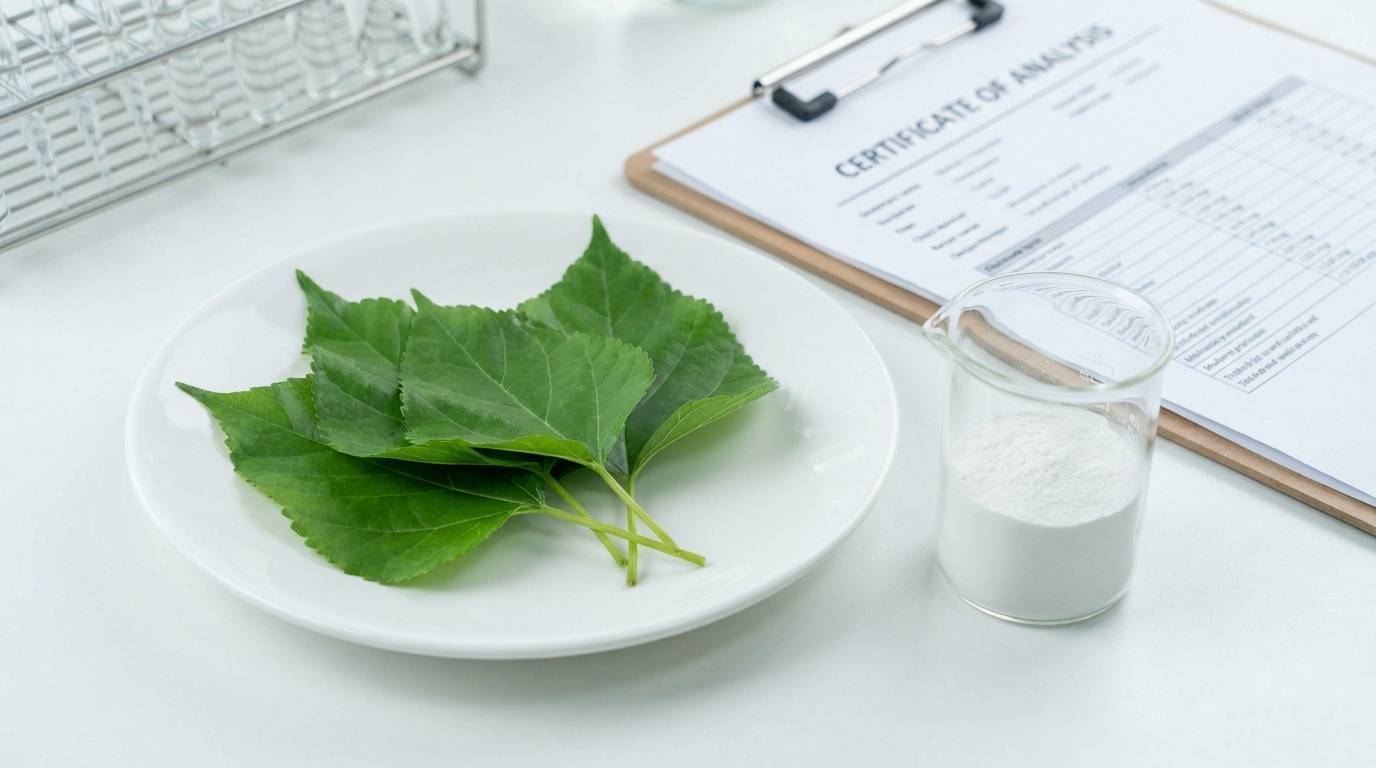
Mulberry leaf extract has emerged as one of the most commercially significant botanical extracts in the past five years, driven by the global weight management supplement market. The active compound — 1-deoxynojirimycin (DNJ) — has been the subject of extensive research for its role in carbohydrate metabolism.
The global mulberry leaf extract market exceeded $400 million in 2025, with strong growth in:
For B2B buyers, sourcing mulberry leaf extract DNJ wholesale involves navigating several specification tiers, identifying quality suppliers, and understanding the application-specific requirements.
This guide covers the 7 critical specifications, 5 quality issues to watch for, and a structured approach to finding a reliable wholesale supplier.
1-Deoxynojirimycin (DNJ) is a naturally occurring iminosugar found in mulberry leaves (Morus alba). It functions as an alpha-glucosidase inhibitor — slowing the breakdown of complex carbohydrates into simple sugars in the digestive tract. This mechanism has made DNJ a popular ingredient in weight management and blood sugar support formulations.
Low-Grade (0.5%-1% DNJ):
– General health supplements
– Functional food and beverage applications
– Cost-sensitive formulations
– Typical price: $25-50/kg
Standard-Grade (1%-2% DNJ):
– Entry-level weight management supplements
– Blood sugar support formulations
– Typical price: $50-90/kg
Mid-Grade (2%-5% DNJ):
– Mid-tier weight management supplements
– Combination formulations (DNJ + berberine, etc.)
– Typical price: $100-180/kg
High-Grade (5%-10% DNJ):
– Premium weight management supplements
– Pharmaceutical research
– Combination formulations requiring lower dosage
– Typical price: $200-450/kg
Ultra-High (10%+ DNJ):
– Pharmaceutical research
– Specialty applications
– Reference standards
– Typical price: $450-1000/kg
The price scaling reflects the concentration process required — higher DNJ content requires more raw material and more sophisticated purification.
| Compound | Typical Content | Function |
|---|---|---|
| DNJ (1-deoxynojirimycin) | 0.5%-10% | Alpha-glucosidase inhibitor |
| Rutin | 0.5%-5% | Antioxidant, vascular health |
| Isoquercitrin | 0.1%-2% | Antioxidant |
| Chlorogenic Acid | 0.5%-3% | Antioxidant, metabolic health |
| Flavonoids (total) | 5%-30% | Combined antioxidant activity |
| Polysaccharides | 5%-20% | Immune support, gut health |
The total flavonoid content is often used as a quality indicator for mulberry leaf extract. Suppliers offering both DNJ specification and total flavonoid content are typically more sophisticated.
The supplier must specify the analytical method for DNJ quantification:
Suppliers who claim specific DNJ content without method specification are unreliable. The HPLC-RI method can produce variable results between labs; HPLC-PAD is the most reproducible.
Request HPLC chromatograms from 2-3 recent batches. A proper chromatogram should show:
Mulberry plants are known to accumulate heavy metals, especially when grown near industrial areas. Required testing:
| Heavy Metal | USP Limit | Typical Range in Quality Extracts |
|---|---|---|
| Lead (Pb) | < 5 ppm | < 1 ppm |
| Arsenic (As) | < 1.5 ppm | < 0.5 ppm |
| Cadmium (Cd) | < 0.5 ppm | < 0.1 ppm |
| Mercury (Hg) | < 0.1 ppm | < 0.05 ppm |
Mulberry leaves from polluted regions can have lead levels above 10 ppm, which would fail USP standards. Source region matters.
Mulberry leaves in China are typically grown with conventional agriculture, requiring pesticide residue testing for export to US/EU:
EU regulations require testing for 500+ pesticides. A serious supplier will provide multi-residue screens on each COA.
Required for food and supplement applications:
Mulberry leaf extract is hygroscopic (absorbs moisture). LOD specification:
High LOD (>10%) indicates poor drying or improper packaging, leading to shorter shelf life and microbial risk.
Look for manufacturing partners with:
Verify certificates through the issuing body’s database.
A common problem: supplier claims 2% DNJ, but independent testing shows 1.4% DNJ. This is often due to:
Solution: Work with suppliers who provide:
– Recent batch COAs (within 2 months)
– In-house HPLC-PAD testing capability
– Reference standards for DNJ quantification
Mulberry trees in industrial regions of China accumulate lead and cadmium. Some suppliers source from these lower-cost regions, resulting in heavy metal test failures.
Solution:
– Ask about source region (Yunnan, Hunan, Sichuan have cleaner profiles)
– Test every batch at your lab or third-party
– Consider organic certification (organic mulberry is grown without industrial pollutants)
Some low-cost suppliers have been caught adulterating mulberry leaf extract with:
Solution:
– Test using HPLC fingerprinting
– Verify botanical source (Morus alba specifically)
– Look for species-specific markers in COA
A quality mulberry leaf extract powder should be:
Off-color or off-odor indicates oxidation, contamination, or aging.
Mid-grade and high-grade mulberry leaf extract should dissolve in water at recommended usage rates. Cloudy or sediment-laden solutions indicate:
Solution: Test solubility in your specific formulation before bulk order.
DNJ extraction is specialized chemistry. The largest manufacturer by volume is not necessarily the best for quality. Look for suppliers focused on quality metrics and consistency.
HPLC-RI is a valid method, but the supplier must use a DNJ reference standard. If the supplier cannot show comparison to a standard, the quantification is unreliable.
Mulberry leaf extract should be from Morus alba (white mulberry). Suppliers who do not specify the species may be using cheaper Morus species (Morus rubra, Morus nigra) with different DNJ profiles.
Genuine high-grade DNJ content (>5%) requires specific extraction and purification processes. Suppliers offering “any DNJ content on request” at low MOQs are likely blending low-grade extract with synthetic DNJ.
The first batch COA says “DNJ 2.1%,” the second batch says “DNJ 1.7%,” the third says “DNJ 2.4%.” Wide variation suggests poor process control.
Order 100-200g samples from 2-3 candidate suppliers. Test at:
Test for:
– DNJ content (vs supplier claim)
– Heavy metals
– Microbial limits
– HPLC fingerprint
For orders above $100,000, arrange a manufacturing partner visit. Verify:
Ask for 2-3 US/EU customers. Call them directly. Ask about:
Request COAs from 3-5 recent batches. Check for:
We work with manufacturing partners in China that produce mulberry leaf extract from Morus alba leaves sourced primarily from:
Our partner manufacturers hold:
For each mulberry leaf extract DNJ inquiry, we:
For B2B buyers evaluating a mulberry leaf extract DNJ wholesale supplier, contact us for a sample request and we will provide 2-3 candidate samples for side-by-side testing.
Most clinical studies on mulberry leaf extract for weight management use 1%-2% DNJ at 200-500 mg per serving. Higher DNJ content allows lower dosage, but clinical evidence is stronger for the 1%-2% range. Combination with berberine or gymnema shows synergistic effects.
Studies have shown mulberry leaf extract to be safe at typical usage rates (200-500 mg per serving, 1%-2% DNJ content). No significant adverse effects have been reported in clinical trials lasting 12 weeks. Long-term safety data beyond 12 weeks is limited.
Mulberry leaf extract may interact with diabetes medications by enhancing their blood sugar-lowering effect. Patients on insulin, sulfonylureas, or metformin should consult healthcare providers. Mild interactions with anticoagulants have also been reported.
Store in sealed containers, away from heat, light, and moisture. Recommended conditions: 25°C, <60% relative humidity. Under proper storage, mulberry leaf extract has a shelf life of 24 months with minimal DNJ loss.
Yes, significantly. Mulberry leaf extract (Morus alba leaves) is standardized for DNJ and used in weight management applications. Mulberry fruit extract (Morus alba fruit) is standardized for anthocyanins and used in antioxidant applications. These are different ingredients with different specifications and applications.
Both have alpha-glucosidase inhibiting activity, but through different mechanisms:
– Mulberry leaf extract (DNJ): Inhibits alpha-glucosidase enzyme directly
– Berberine: Activates AMPK pathway, improves insulin sensitivity
Studies show combination is more effective than either alone. Both ingredients can be combined in blood sugar support formulations.
Sourcing mulberry leaf extract DNJ wholesale requires careful evaluation of 7 critical specifications: DNJ quantification method, HPLC chromatograms, heavy metals, pesticide residues, microbial limits, LOD, and manufacturing partner certifications.
Watch for 5 common quality issues: DNJ content below specification, heavy metal contamination, adulteration, color/odor problems, and poor solubility. Avoid 5 red flags: “largest manufacturer” claims, HPLC-RI without standard comparison, no source declaration, “custom DNJ content on request,” and inconsistent documentation.
For B2B buyers sourcing mulberry leaf extract for weight management, blood sugar support, or functional food applications, a structured evaluation process with sample testing, reference checks, and pilot orders is essential.
Nourish Ingredients works with audited mulberry leaf extract manufacturing partners and provides full documentation and sample coordination for US and EU buyers.
Related Articles:
– Mulberry Leaf Extract DNJ Clinical Evidence: A B2B Buyer’s Guide
– Weight Management Supplement Formulation: DNJ + Berberine + Gymnema Synergy
– How to Read a Botanical Extract COA: A B2B Buyer’s Guide
– Third-Party Testing: SGS, Eurofins, and Intertek Compared
External Resources:
– PubMed DNJ Clinical Studies
– FDA Structure-Function Claims Guidance
– USP Botanical Extract Monographs
Disclaimer: Specifications, regulations, and supplier capabilities change over time. Statements about health effects are not intended to diagnose, treat, cure, or prevent any disease. Always verify current information with your supplier and applicable regulatory bodies.
Why Quality Verification Is the Most Important Skill A 2024 industry survey found that 60% of buyers who had a…
When a botanical extract supplier tells you their product is “lab tested,” the natural next question is: which lab, which…
Regulation EU Novel Food Regulation Update 2026: What Botanical Extract Importers Need to Know June 2026 · 8 min read…